Create charts based on ClickUp time tracking data

Create charts based on ClickUp time tracking data

Create charts based on ClickUp time tracking data

Create charts based on ClickUp time tracking data

If you have enabled time tracking in your workspace, the Estimated time and Actual time will be automatically imported and made available for charts. You can create charts based on time tracking data in the same way you create charts based on task data. You have all the same grouping and filtering options available.

Creating a chart using Asana time tracking data

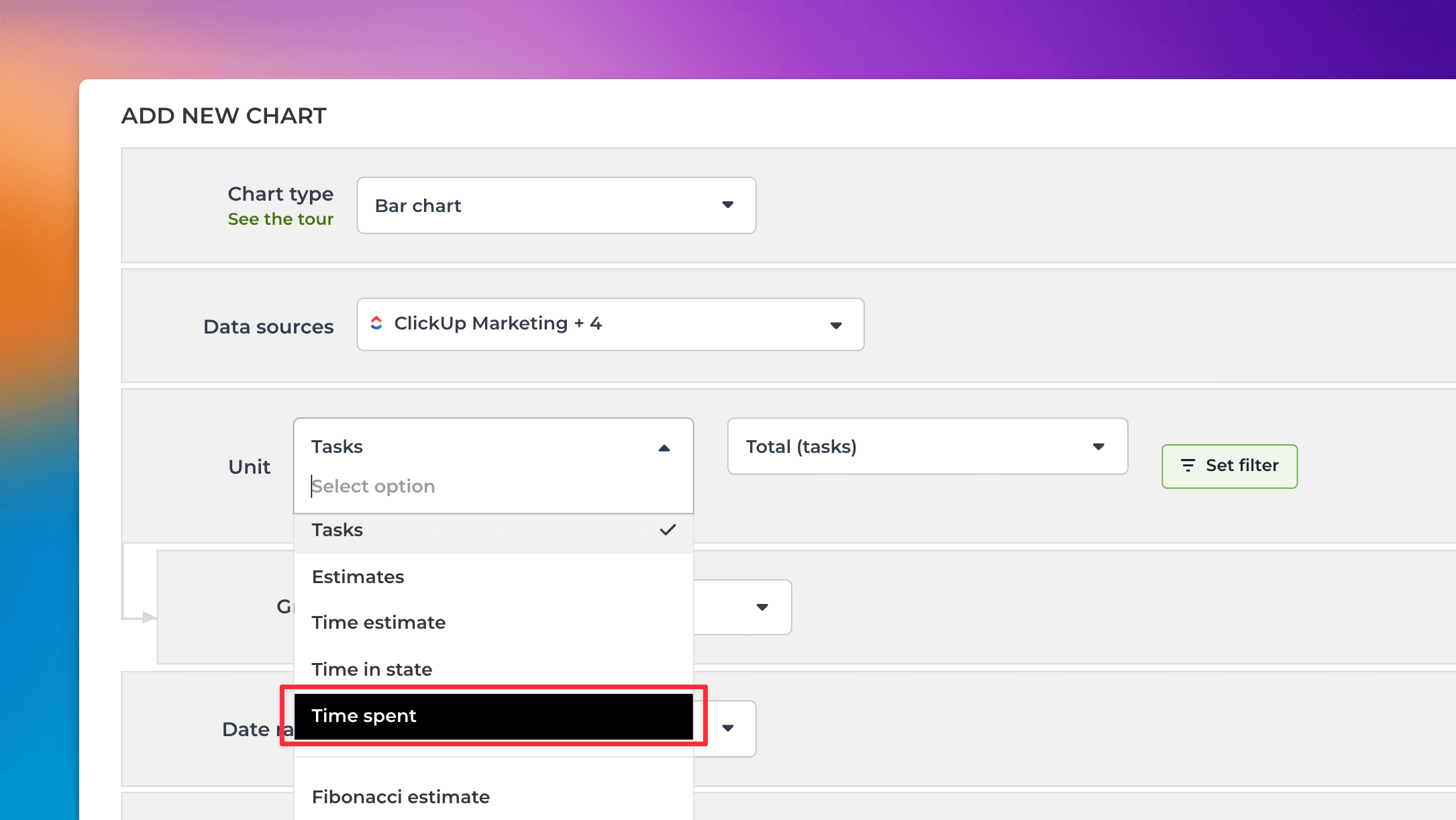
To create a chart using time tracking data, start by clicking Add new chart in the Charts tab. Select Time spent from the Unit menu:
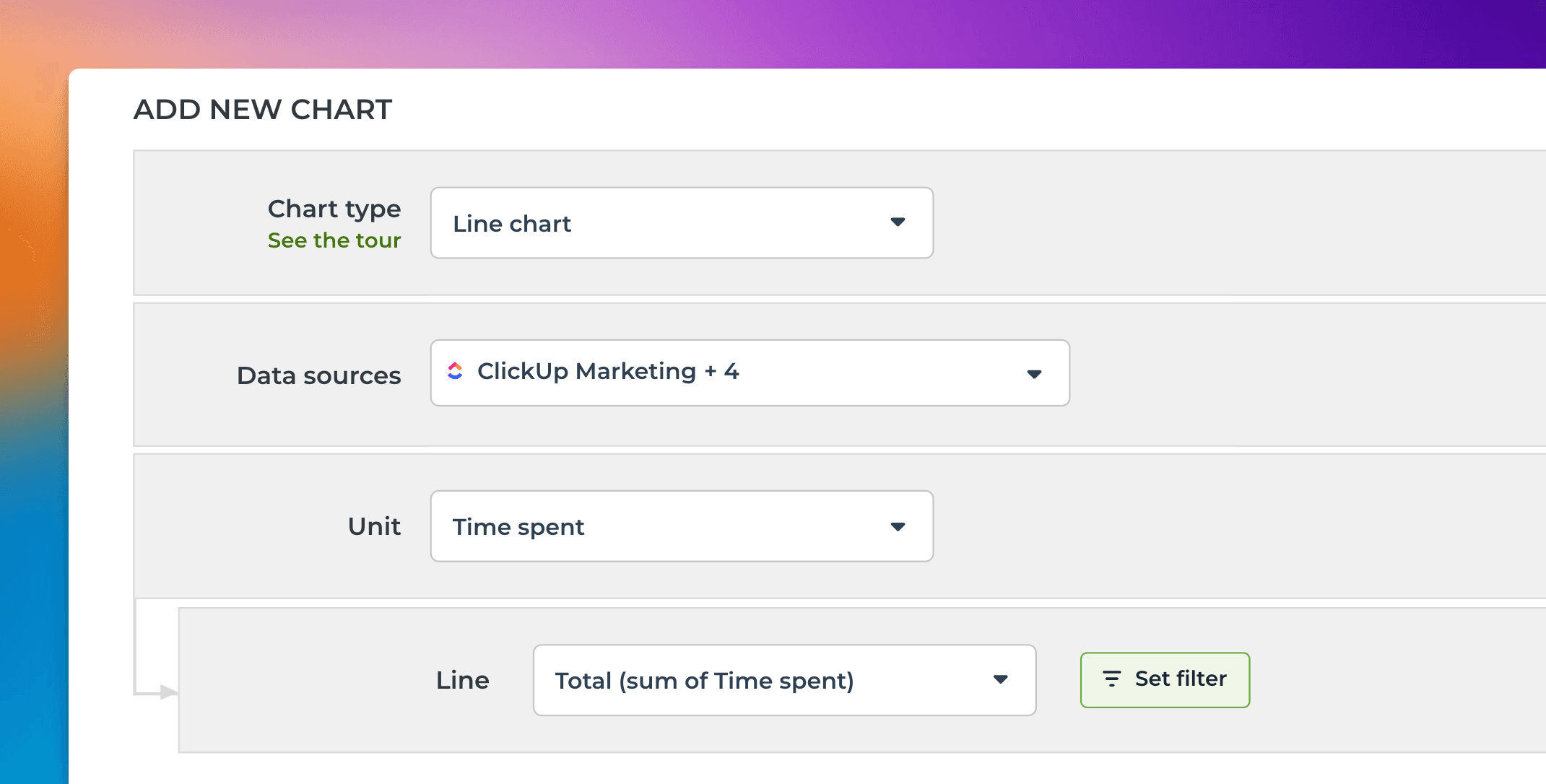
When Time spent is selected as the Unit, the Metric menu contains only one option: Total (sum of Time spent). Here’s an example configuration of a line chart that shows the total amount of hours logged over time:
The Date range refers to when the hours were logged. Here’s the resulting chart:
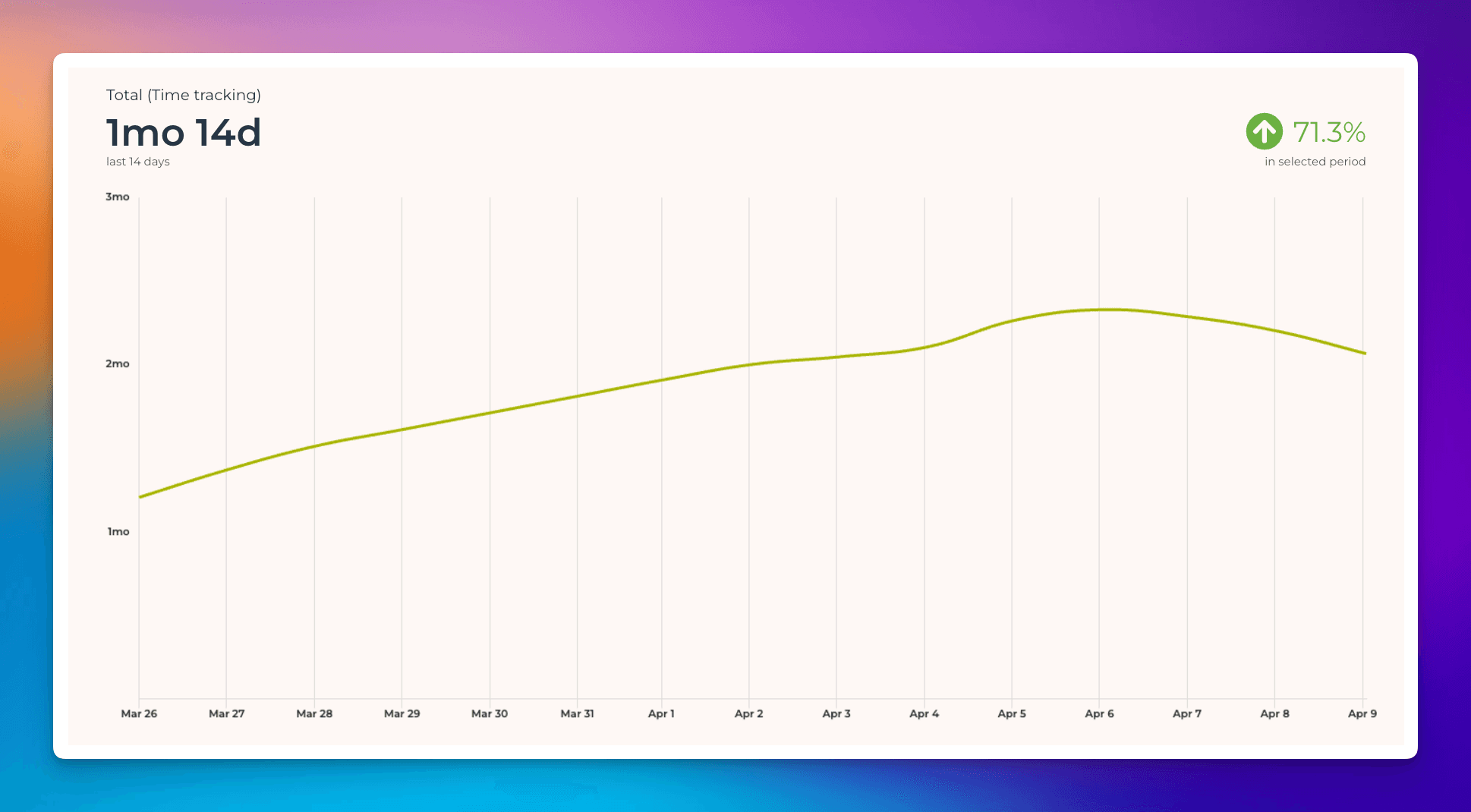
Resulting chart

You can create charts from your top-level tasks, subtasks, or both. You can choose between these options by setting a filter (use the filter Item type).

Creating a chart using Asana time tracking data

To create a chart using time tracking data, start by clicking Add new chart in the Charts tab. Select Time spent from the Unit menu:

When Time spent is selected as the Unit, the Metric menu contains only one option: Total (sum of Time spent). Here’s an example configuration of a line chart that shows the total amount of hours logged over time:

The Date range refers to when the hours were logged. Here’s the resulting chart:

Resulting chart

You can create charts from your top-level tasks, subtasks, or both. You can choose between these options by setting a filter (use the filter Item type).

Creating a chart using Asana time tracking data

To create a chart using time tracking data, start by clicking Add new chart in the Charts tab. Select Time spent from the Unit menu:

When Time spent is selected as the Unit, the Metric menu contains only one option: Total (sum of Time spent). Here’s an example configuration of a line chart that shows the total amount of hours logged over time:

The Date range refers to when the hours were logged. Here’s the resulting chart:

Resulting chart

You can create charts from your top-level tasks, subtasks, or both. You can choose between these options by setting a filter (use the filter Item type).

Grouping and filtering by time logged by

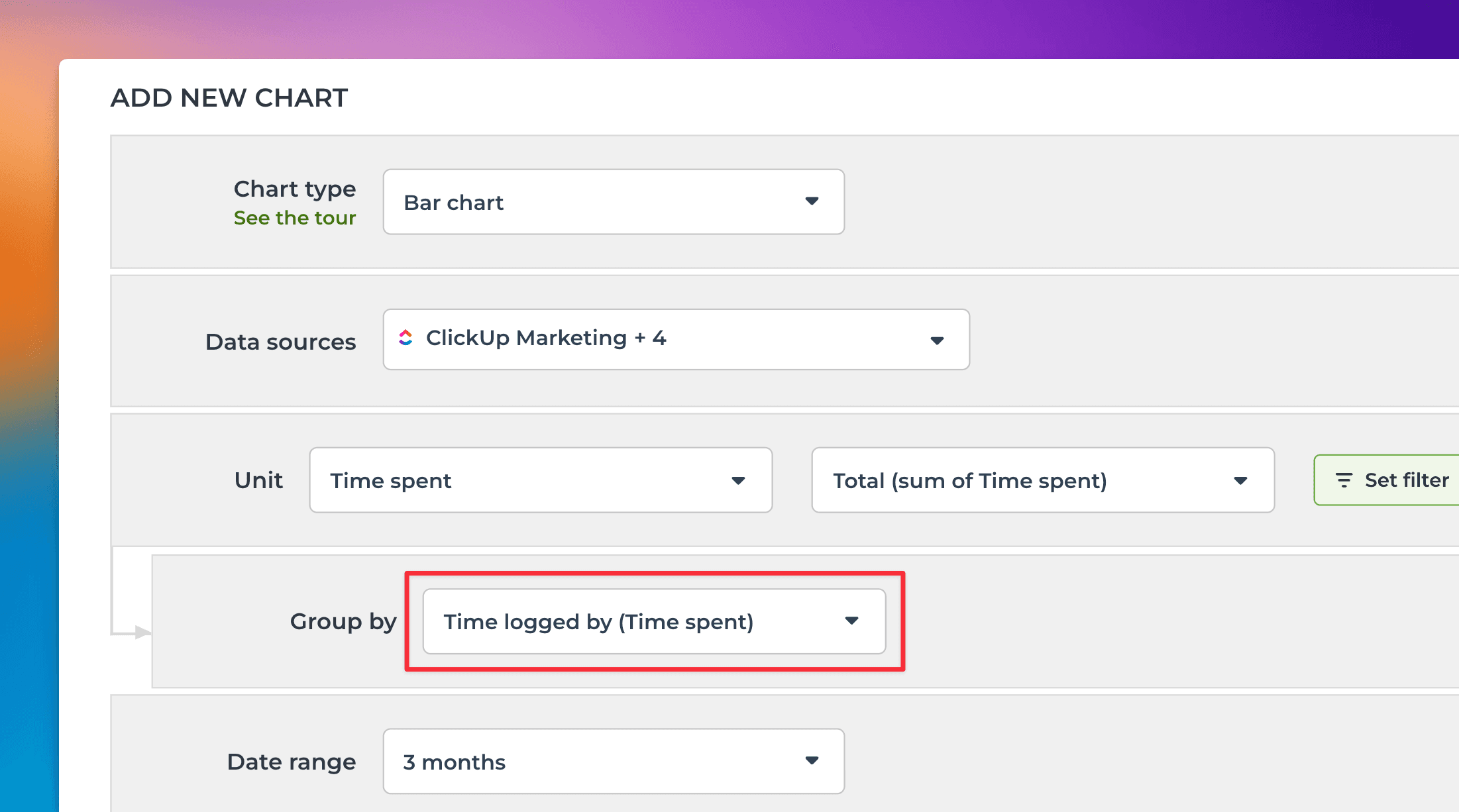
When Time spent is selected as a unit, a special metric called Time logged by allows grouping and filtering based on who logged the hours. Here’s an example chart configuration showing the total amount of hours logged per individual:
And here’s the resulting chart:
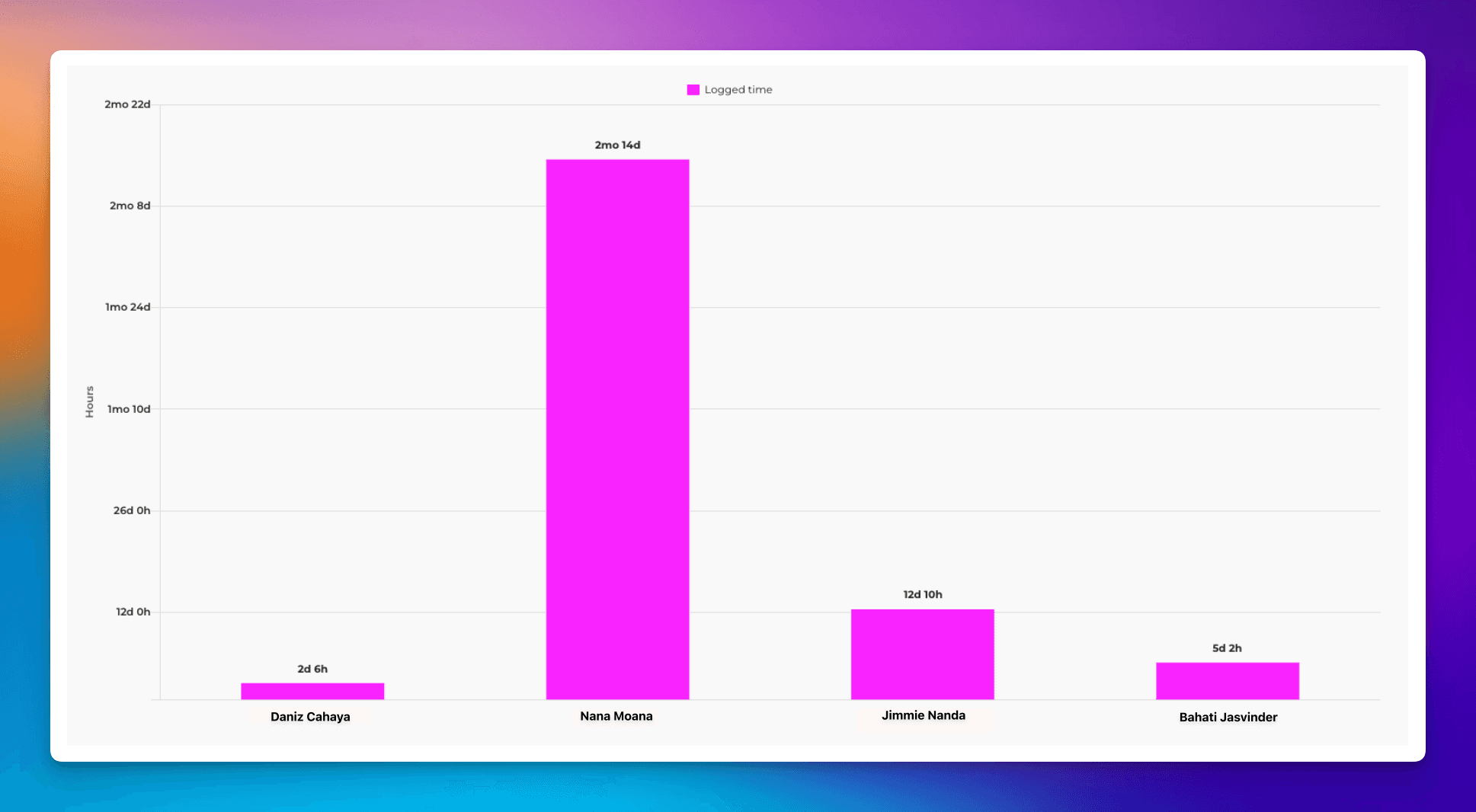
Resulting chart

You can also filter the chart based on this property. In the filter window, you can find the Time logged by (Time spent) option.
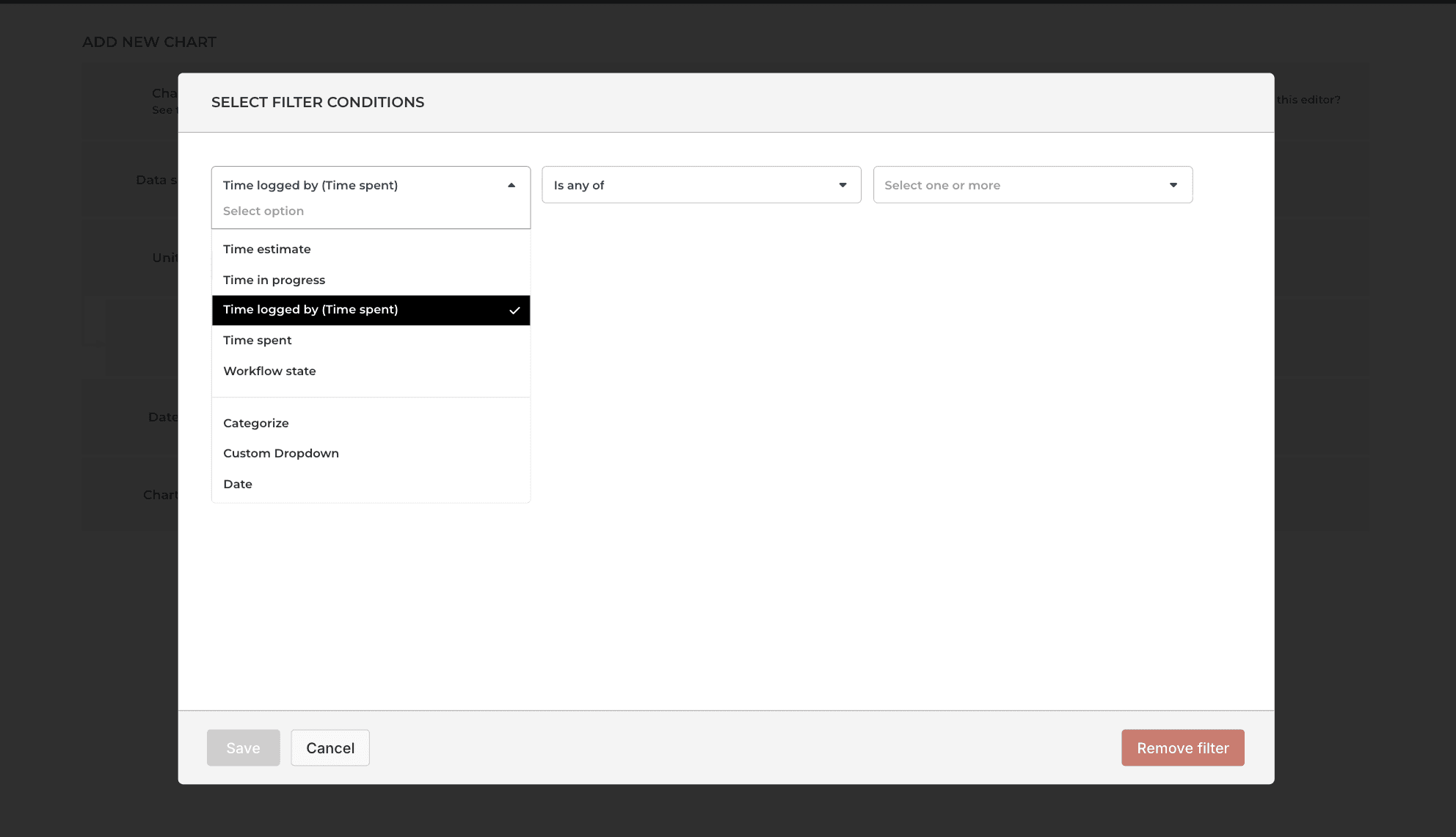
When you select individuals, the chart is filtered accordingly.

Grouping and filtering by time logged by

When Time spent is selected as a unit, a special metric called Time logged by allows grouping and filtering based on who logged the hours. Here’s an example chart configuration showing the total amount of hours logged per individual:

And here’s the resulting chart:

Resulting chart

You can also filter the chart based on this property. In the filter window, you can find the Time logged by (Time spent) option.

When you select individuals, the chart is filtered accordingly.

Grouping and filtering by time logged by

When Time spent is selected as a unit, a special metric called Time logged by allows grouping and filtering based on who logged the hours. Here’s an example chart configuration showing the total amount of hours logged per individual:

And here’s the resulting chart:

Resulting chart

You can also filter the chart based on this property. In the filter window, you can find the Time logged by (Time spent) option.

When you select individuals, the chart is filtered accordingly.

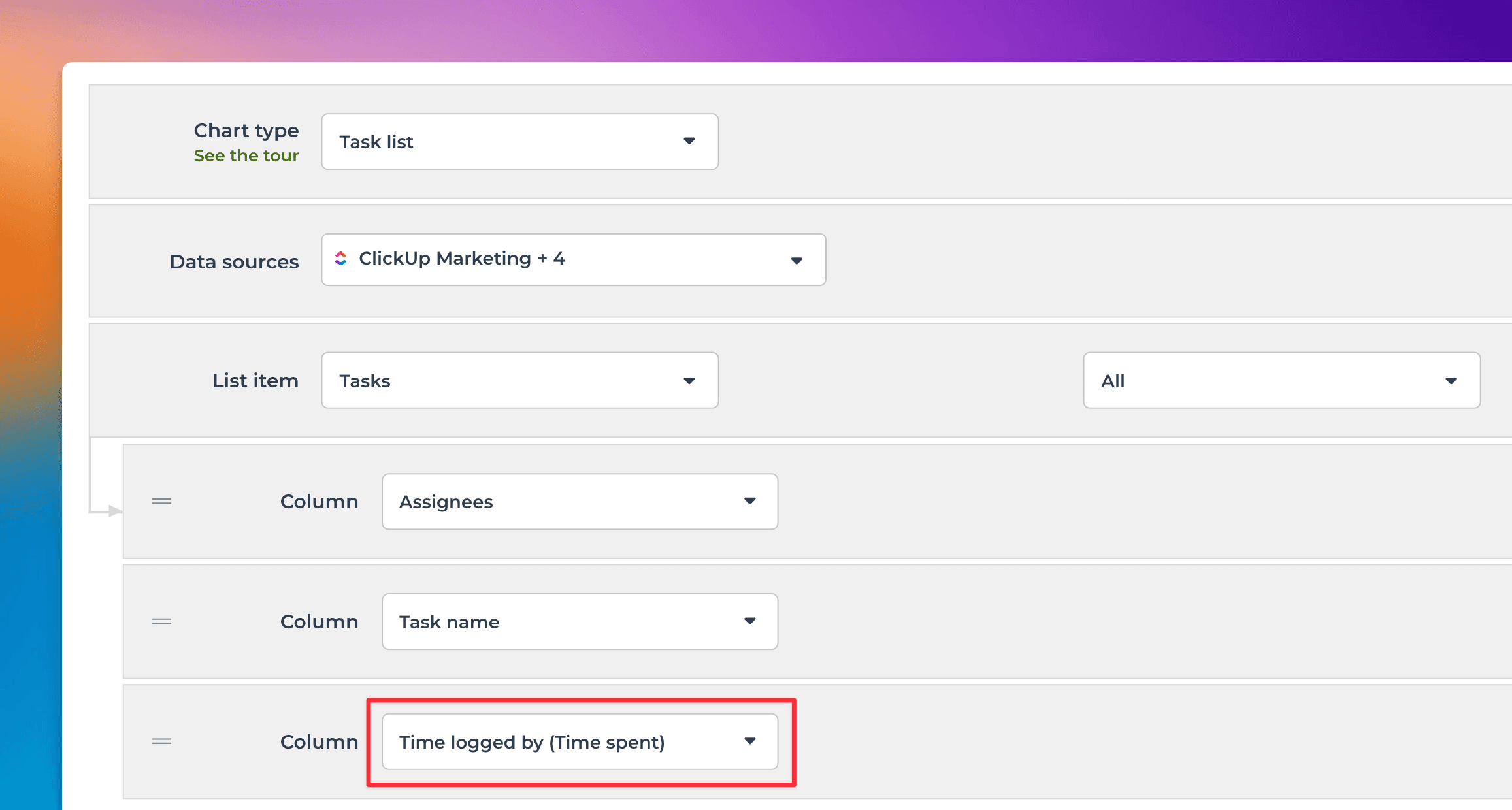
Time logged by individual by task

You can track time logged by an individual in a Task list by adding Time logged by (Time spent) as a column:
That allows you to see how much time each team member logged for each item:
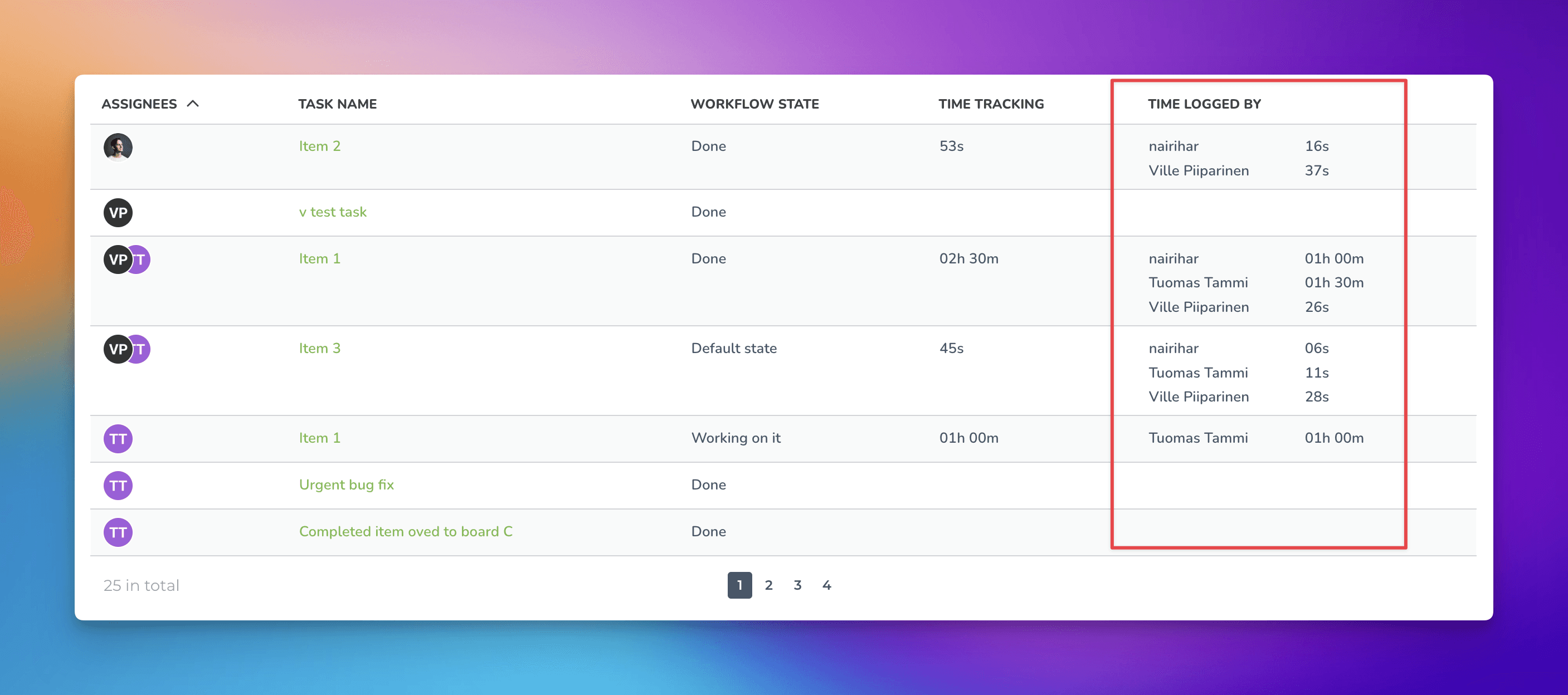
Time logged by result

The numbers are summed so that you can see each team member's total time logged so far.

Time logged by individual by task

You can track time logged by an individual in a Task list by adding Time logged by (Time spent) as a column:

That allows you to see how much time each team member logged for each item:

Time logged by result

The numbers are summed so that you can see each team member's total time logged so far.

Time logged by individual by task

You can track time logged by an individual in a Task list by adding Time logged by (Time spent) as a column:

That allows you to see how much time each team member logged for each item:

Time logged by result

The numbers are summed so that you can see each team member's total time logged so far.

Time logged by individual by task within a date range

To see how many hours have been logged by team member by task within a time period, select Time spent (within date range) from the menu:
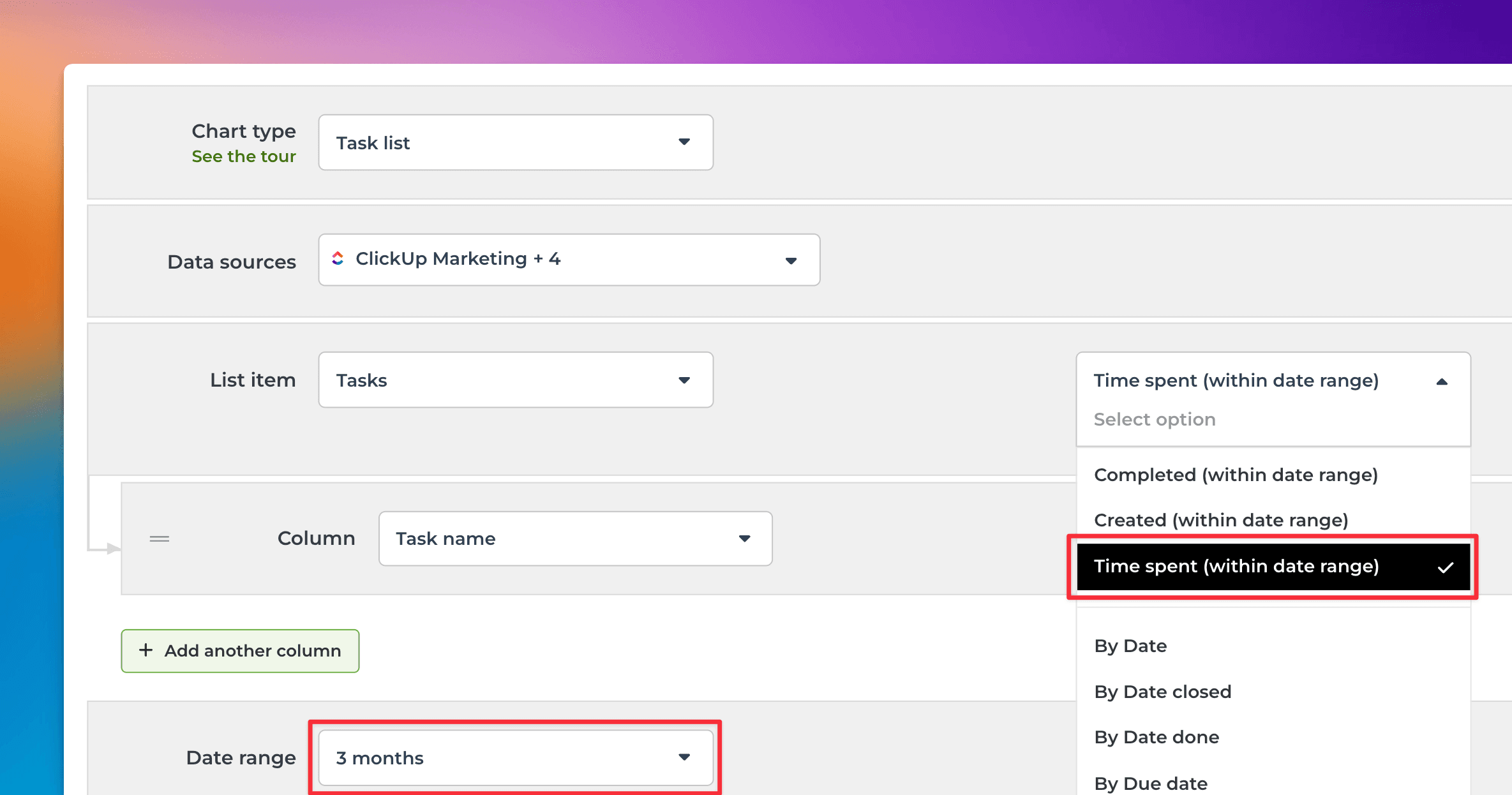
Selecting it reveals a date range menu that allows you to narrow the results to tasks with time logged within the selected period.
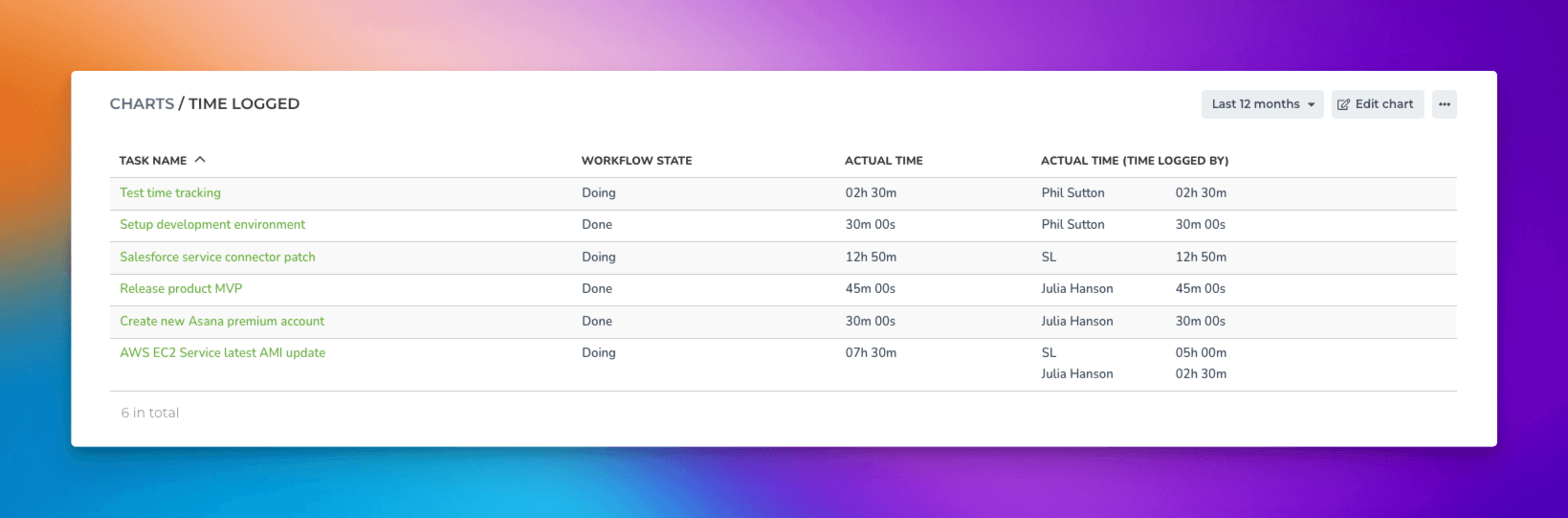
Reveaks date range menu in chart

Now the Time spent and Time logged by (Time spent) show the total time logged to tasks within the specified date range. You can use the filter feature to narrow the list to any subset of tasks.

Time logged by individual by task within a date range

To see how many hours have been logged by team member by task within a time period, select Time spent (within date range) from the menu:

Selecting it reveals a date range menu that allows you to narrow the results to tasks with time logged within the selected period.

Reveaks date range menu in chart

Now the Time spent and Time logged by (Time spent) show the total time logged to tasks within the specified date range. You can use the filter feature to narrow the list to any subset of tasks.

Time logged by individual by task within a date range

To see how many hours have been logged by team member by task within a time period, select Time spent (within date range) from the menu:

Selecting it reveals a date range menu that allows you to narrow the results to tasks with time logged within the selected period.

Reveaks date range menu in chart

Now the Time spent and Time logged by (Time spent) show the total time logged to tasks within the specified date range. You can use the filter feature to narrow the list to any subset of tasks.

Setting a quick filter for selecting an individual

In the chart settings, you can configure a quick filter that will be shown at the top of the chart. If you set a quick filter for Time logged by (Actual time), you can easily filter the report to see each individual's timesheet.

In the chart settings, use the toggle to enable the quick filter:
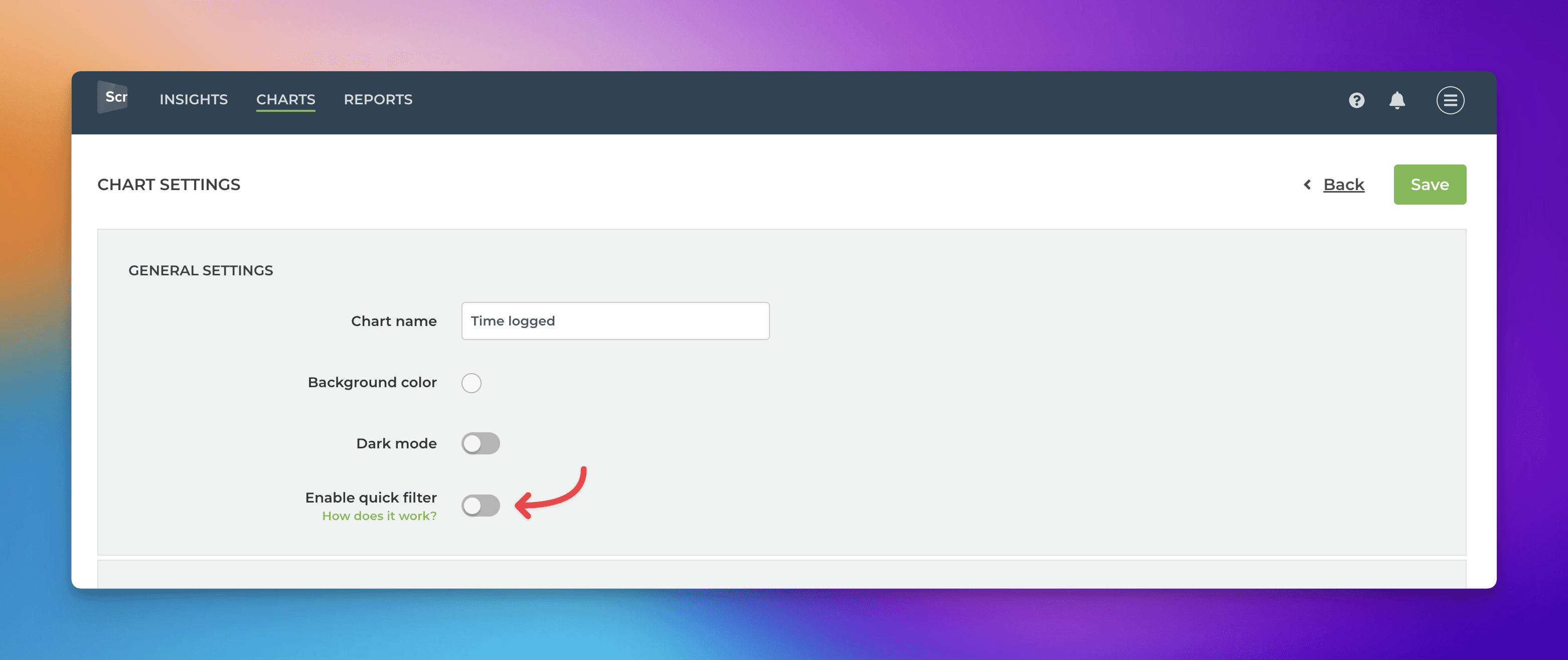
Enable quick filter

Clicking the toggle reveals the filter options. These are the same options as when setting a filter in the chart editor. Select Time logged by (Time spent) from the list:
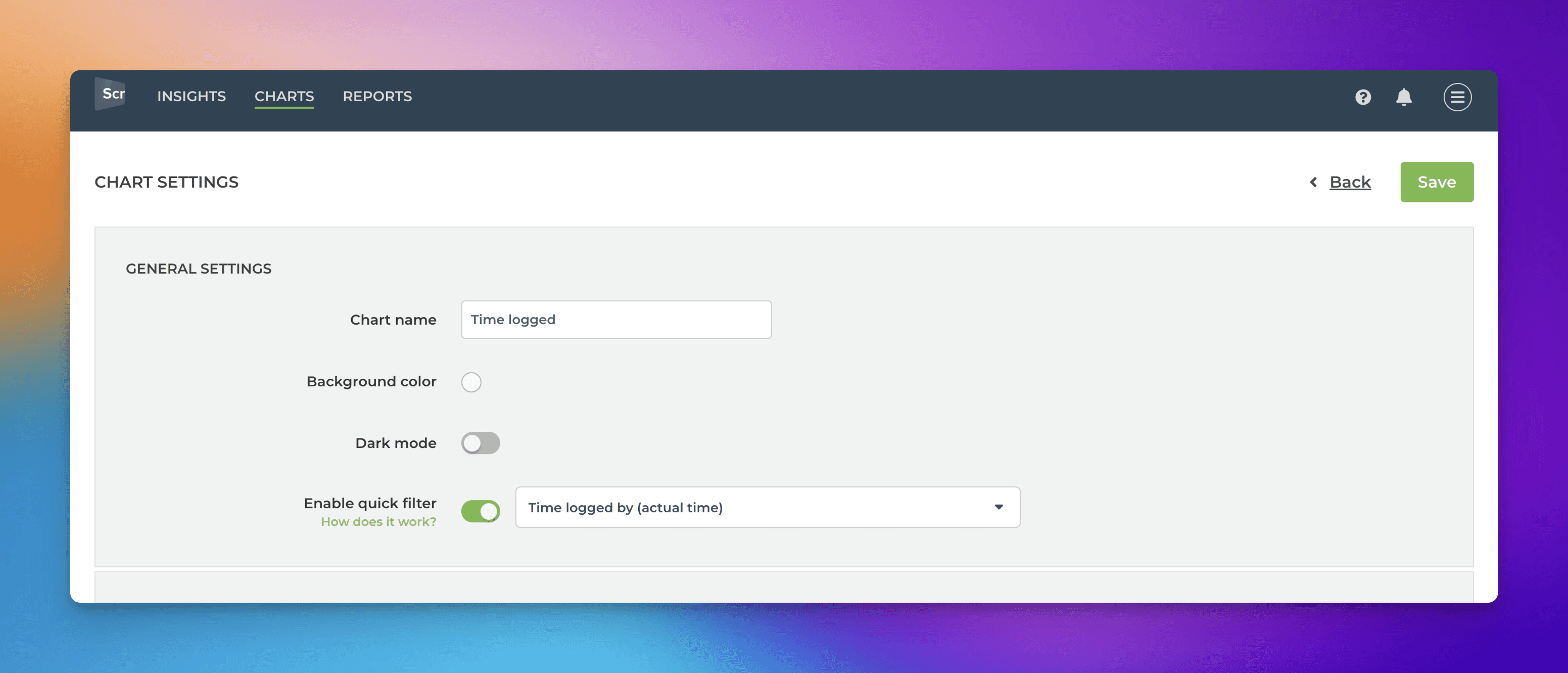
Time logged by in quick filter

Once a quick filter is enabled, you can filter the list by any individual by picking a name from the menu:
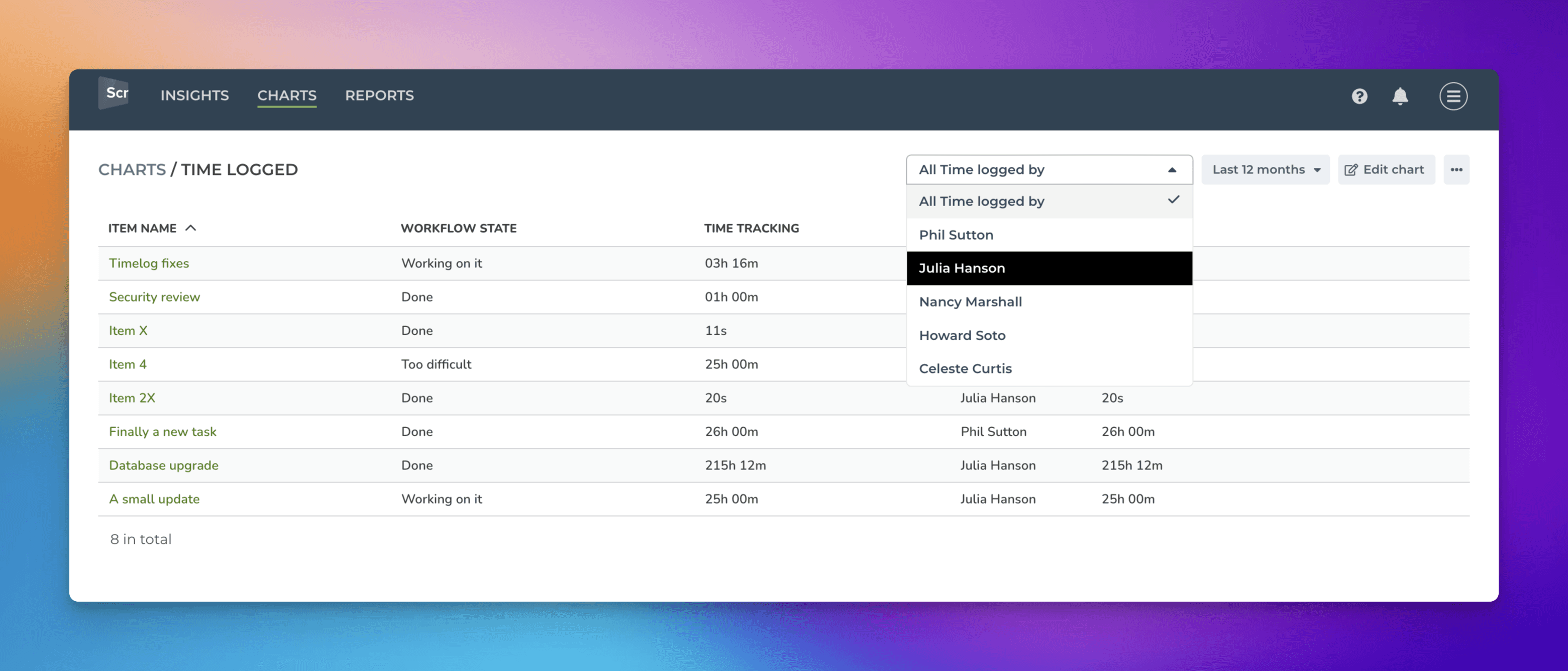
Select individually from the menu

Setting a quick filter for selecting an individual

In the chart settings, you can configure a quick filter that will be shown at the top of the chart. If you set a quick filter for Time logged by (Actual time), you can easily filter the report to see each individual's timesheet.

In the chart settings, use the toggle to enable the quick filter:

Enable quick filter

Clicking the toggle reveals the filter options. These are the same options as when setting a filter in the chart editor. Select Time logged by (Time spent) from the list:

Time logged by in quick filter

Once a quick filter is enabled, you can filter the list by any individual by picking a name from the menu:

Select individually from the menu

Setting a quick filter for selecting an individual

In the chart settings, you can configure a quick filter that will be shown at the top of the chart. If you set a quick filter for Time logged by (Actual time), you can easily filter the report to see each individual's timesheet.

In the chart settings, use the toggle to enable the quick filter:

Enable quick filter

Clicking the toggle reveals the filter options. These are the same options as when setting a filter in the chart editor. Select Time logged by (Time spent) from the list:

Time logged by in quick filter

Once a quick filter is enabled, you can filter the list by any individual by picking a name from the menu:

Select individually from the menu

Create a time-tracking report from template

You can create a time-tracking report by using a report template. Go to the Reports tab and click Add new report:

Add new report

A modal opens, showing the available templates. Select Time tracking for Asana:

Select time tracking for asana

A report is created containing time tracking data from the selected Asana projects.

Report created

Create a time-tracking report from template

You can create a time-tracking report by using a report template. Go to the Reports tab and click Add new report:

Add new report

A modal opens, showing the available templates. Select Time tracking for Asana:

Select time tracking for asana

A report is created containing time tracking data from the selected Asana projects.

Report created

Create a time-tracking report from template

You can create a time-tracking report by using a report template. Go to the Reports tab and click Add new report:

Add new report

A modal opens, showing the available templates. Select Time tracking for Asana:

Select time tracking for asana

A report is created containing time tracking data from the selected Asana projects.

Report created

FAQ

Common questions

What is a data source in the case of ClickUp?

A data source is a Space. The pricing is based on the number of spaces you explicitly import to Screenful, not the total number of spaces in ClickUp. One data source can contain any number of lists and folders. You can compare plans on the pricing page.

You can import data sources from all the tools we support in the same Screenful account. Learn more about managing data sources.

A data source is a Space. The pricing is based on the number of spaces you explicitly import to Screenful, not the total number of spaces in ClickUp. One data source can contain any number of lists and folders. You can compare plans on the pricing page.

You can import data sources from all the tools we support in the same Screenful account. Learn more about managing data sources.

How do I manage the subscription?

You can manage the subscription in the billing settings. The location of the billing settings depends on the product you are subscribed to. You can learn more by following the instructions in this guide.

You can manage the subscription in the billing settings. The location of the billing settings depends on the product you are subscribed to. You can learn more by following the instructions in this guide.

Will Screenful make changes to my data, or is my data affected in any way?

We do not make changes to your data. We only read it via the API of your tool. Screenful is only for reporting and analytics. It does not update any data within your tools.

We do not make changes to your data. We only read it via the API of your tool. Screenful is only for reporting and analytics. It does not update any data within your tools.

How often is data updated?

All data sources are synced automatically once per hour. Changing settings or configuration will trigger additional sync so your data is at most one hour old. You can sync data manually at any time in the sync settings.

All data sources are synced automatically once per hour. Changing settings or configuration will trigger additional sync so your data is at most one hour old. You can sync data manually at any time in the sync settings.

Can I create charts with a prompt?

Yes, you can create charts with a prompt and ask questions about a chart by using the Screenful AI Assistant. The assistant combines the leading LLMs with advanced multidimensional data analytics to help you understand and interpret your data.

Yes, you can create charts with a prompt and ask questions about a chart by using the Screenful AI Assistant. The assistant combines the leading LLMs with advanced multidimensional data analytics to help you understand and interpret your data.

What does Reaction time, Lead time, Cycle time mean?

What is the difference between these metrics?
Reaction time = time before the work was started
Cycle time = time from start to completion
Lead time = Reaction time + Cycle time
Timing metrics explained: Lead time vs Cycle time

How is the reaction time calculated?
Reaction time starts running when a task is moved into a state that is mapped to the "Not started" in the workflow mapping. The reaction time stops when the task is moved out from that state. If the task is never placed into a state that is mapped to the “Not started” workflow state, then the reaction time is zero.

What if tasks skip lists/columns, or there is no sequential workflow?
The timing information is based on how long items stay in the workflow states that are mapped to "In progress" in the workflow mapping. There is no need for sequential progress, and it is totally fine if tasks skip some of the workflow steps.

What if a task is moved from the “not started” state directly to “done” without going through any of the “in progress” states?
In that case, the cycle time will be zero.

How does the cycle time work if a task is moved into "in progress" and then back to "not started yet"? Similarly, what happens if a card is archived while it's in progress?
Cycle time is calculated only for completed tasks, so in both of those cases, cycle time would be undefined.

If a task is moved from "in progress" to "done", but then back to "in progress" again for additional work would this time be added to the cycle time?
Cycle time is counted only when the task is in progress, so the time spent in the "done" state is not included in the calculation. 

When is a task created? Does the clock start when a task is created or when it is put in the "next" state (or equivalent)?
The clock starts when a task is moved to a workflow state that is mapped to the "not started" or "in progress" workflow state.

Are weekends included in the cycle time calculations?
Weekends are included in the calculations by default, but you can change that in the chart settings by selecting 'Exclude non-business hours. See How to set weekend days and office hours 


What is the difference between these metrics?
Reaction time = time before the work was started
Cycle time = time from start to completion
Lead time = Reaction time + Cycle time
Timing metrics explained: Lead time vs Cycle time

How is the reaction time calculated?
Reaction time starts running when a task is moved into a state that is mapped to the "Not started" in the workflow mapping. The reaction time stops when the task is moved out from that state. If the task is never placed into a state that is mapped to the “Not started” workflow state, then the reaction time is zero.

What if tasks skip lists/columns, or there is no sequential workflow?
The timing information is based on how long items stay in the workflow states that are mapped to "In progress" in the workflow mapping. There is no need for sequential progress, and it is totally fine if tasks skip some of the workflow steps.

What if a task is moved from the “not started” state directly to “done” without going through any of the “in progress” states?
In that case, the cycle time will be zero.

How does the cycle time work if a task is moved into "in progress" and then back to "not started yet"? Similarly, what happens if a card is archived while it's in progress?
Cycle time is calculated only for completed tasks, so in both of those cases, cycle time would be undefined.

If a task is moved from "in progress" to "done", but then back to "in progress" again for additional work would this time be added to the cycle time?
Cycle time is counted only when the task is in progress, so the time spent in the "done" state is not included in the calculation. 

When is a task created? Does the clock start when a task is created or when it is put in the "next" state (or equivalent)?
The clock starts when a task is moved to a workflow state that is mapped to the "not started" or "in progress" workflow state.

Are weekends included in the cycle time calculations?
Weekends are included in the calculations by default, but you can change that in the chart settings by selecting 'Exclude non-business hours. See How to set weekend days and office hours 


Are weekends included in the cycle time calculation?

By default yes, but you can specify your working hours and days in the Account Settings.

By default yes, but you can specify your working hours and days in the Account Settings.

Is there a way to remove outliers from the data?

Yes, there are a few different ways you can filter out outliers from the charts, including

  • Filtering by item name

  • Filtering by how long an item has been in progress

  • Setting a label and filtering out based on that label

You can learn more from this guide: How to remove outliers from data?

Yes, there are a few different ways you can filter out outliers from the charts, including

  • Filtering by item name

  • Filtering by how long an item has been in progress

  • Setting a label and filtering out based on that label

You can learn more from this guide: How to remove outliers from data?

Does this support my specific workflow or do I have to use some specific states like "open", "in progress" and "done"?

You are not limited to any specific set of states or a workflow. You can configure your own workflow, if such exists, and you can use that in your reporting. It's also ok if you don't have any workflow in your boards, as can create reports based on any other criteria by setting a filter.

You are not limited to any specific set of states or a workflow. You can configure your own workflow, if such exists, and you can use that in your reporting. It's also ok if you don't have any workflow in your boards, as can create reports based on any other criteria by setting a filter.

Can I embed these charts into my intranet?

You can embed any custom chart or report to any web page using the embed code. Learn more about the sharing feature from the online guide

You can embed any custom chart or report to any web page using the embed code. Learn more about the sharing feature from the online guide

I can’t find an answer to my question

The Getting Started Guide contains Instructions for setting up Screenful.

See also our Accounts & Pricing FAQ.

Check out our knowledge base and video tutorials, or get in touch by emailing support@screenful.com

The Getting Started Guide contains Instructions for setting up Screenful.

See also our Accounts & Pricing FAQ.

Check out our knowledge base and video tutorials, or get in touch by emailing support@screenful.com

FAQ

Common questions

What is a data source in the case of ClickUp?

A data source is a Space. The pricing is based on the number of spaces you explicitly import to Screenful, not the total number of spaces in ClickUp. One data source can contain any number of lists and folders. You can compare plans on the pricing page.

You can import data sources from all the tools we support in the same Screenful account. Learn more about managing data sources.

A data source is a Space. The pricing is based on the number of spaces you explicitly import to Screenful, not the total number of spaces in ClickUp. One data source can contain any number of lists and folders. You can compare plans on the pricing page.

You can import data sources from all the tools we support in the same Screenful account. Learn more about managing data sources.

How do I manage the subscription?

You can manage the subscription in the billing settings. The location of the billing settings depends on the product you are subscribed to. You can learn more by following the instructions in this guide.

You can manage the subscription in the billing settings. The location of the billing settings depends on the product you are subscribed to. You can learn more by following the instructions in this guide.

Will Screenful make changes to my data, or is my data affected in any way?

We do not make changes to your data. We only read it via the API of your tool. Screenful is only for reporting and analytics. It does not update any data within your tools.

We do not make changes to your data. We only read it via the API of your tool. Screenful is only for reporting and analytics. It does not update any data within your tools.

How often is data updated?

All data sources are synced automatically once per hour. Changing settings or configuration will trigger additional sync so your data is at most one hour old. You can sync data manually at any time in the sync settings.

All data sources are synced automatically once per hour. Changing settings or configuration will trigger additional sync so your data is at most one hour old. You can sync data manually at any time in the sync settings.

Can I create charts with a prompt?

Yes, you can create charts with a prompt and ask questions about a chart by using the Screenful AI Assistant. The assistant combines the leading LLMs with advanced multidimensional data analytics to help you understand and interpret your data.

Yes, you can create charts with a prompt and ask questions about a chart by using the Screenful AI Assistant. The assistant combines the leading LLMs with advanced multidimensional data analytics to help you understand and interpret your data.

What does Reaction time, Lead time, Cycle time mean?

What is the difference between these metrics?
Reaction time = time before the work was started
Cycle time = time from start to completion
Lead time = Reaction time + Cycle time
Timing metrics explained: Lead time vs Cycle time

How is the reaction time calculated?
Reaction time starts running when a task is moved into a state that is mapped to the "Not started" in the workflow mapping. The reaction time stops when the task is moved out from that state. If the task is never placed into a state that is mapped to the “Not started” workflow state, then the reaction time is zero.

What if tasks skip lists/columns, or there is no sequential workflow?
The timing information is based on how long items stay in the workflow states that are mapped to "In progress" in the workflow mapping. There is no need for sequential progress, and it is totally fine if tasks skip some of the workflow steps.

What if a task is moved from the “not started” state directly to “done” without going through any of the “in progress” states?
In that case, the cycle time will be zero.

How does the cycle time work if a task is moved into "in progress" and then back to "not started yet"? Similarly, what happens if a card is archived while it's in progress?
Cycle time is calculated only for completed tasks, so in both of those cases, cycle time would be undefined.

If a task is moved from "in progress" to "done", but then back to "in progress" again for additional work would this time be added to the cycle time?
Cycle time is counted only when the task is in progress, so the time spent in the "done" state is not included in the calculation. 

When is a task created? Does the clock start when a task is created or when it is put in the "next" state (or equivalent)?
The clock starts when a task is moved to a workflow state that is mapped to the "not started" or "in progress" workflow state.

Are weekends included in the cycle time calculations?
Weekends are included in the calculations by default, but you can change that in the chart settings by selecting 'Exclude non-business hours. See How to set weekend days and office hours 


What is the difference between these metrics?
Reaction time = time before the work was started
Cycle time = time from start to completion
Lead time = Reaction time + Cycle time
Timing metrics explained: Lead time vs Cycle time

How is the reaction time calculated?
Reaction time starts running when a task is moved into a state that is mapped to the "Not started" in the workflow mapping. The reaction time stops when the task is moved out from that state. If the task is never placed into a state that is mapped to the “Not started” workflow state, then the reaction time is zero.

What if tasks skip lists/columns, or there is no sequential workflow?
The timing information is based on how long items stay in the workflow states that are mapped to "In progress" in the workflow mapping. There is no need for sequential progress, and it is totally fine if tasks skip some of the workflow steps.

What if a task is moved from the “not started” state directly to “done” without going through any of the “in progress” states?
In that case, the cycle time will be zero.

How does the cycle time work if a task is moved into "in progress" and then back to "not started yet"? Similarly, what happens if a card is archived while it's in progress?
Cycle time is calculated only for completed tasks, so in both of those cases, cycle time would be undefined.

If a task is moved from "in progress" to "done", but then back to "in progress" again for additional work would this time be added to the cycle time?
Cycle time is counted only when the task is in progress, so the time spent in the "done" state is not included in the calculation. 

When is a task created? Does the clock start when a task is created or when it is put in the "next" state (or equivalent)?
The clock starts when a task is moved to a workflow state that is mapped to the "not started" or "in progress" workflow state.

Are weekends included in the cycle time calculations?
Weekends are included in the calculations by default, but you can change that in the chart settings by selecting 'Exclude non-business hours. See How to set weekend days and office hours 


Are weekends included in the cycle time calculation?

By default yes, but you can specify your working hours and days in the Account Settings.

By default yes, but you can specify your working hours and days in the Account Settings.

Is there a way to remove outliers from the data?

Yes, there are a few different ways you can filter out outliers from the charts, including

  • Filtering by item name

  • Filtering by how long an item has been in progress

  • Setting a label and filtering out based on that label

You can learn more from this guide: How to remove outliers from data?

Yes, there are a few different ways you can filter out outliers from the charts, including

  • Filtering by item name

  • Filtering by how long an item has been in progress

  • Setting a label and filtering out based on that label

You can learn more from this guide: How to remove outliers from data?

Does this support my specific workflow or do I have to use some specific states like "open", "in progress" and "done"?

You are not limited to any specific set of states or a workflow. You can configure your own workflow, if such exists, and you can use that in your reporting. It's also ok if you don't have any workflow in your boards, as can create reports based on any other criteria by setting a filter.

You are not limited to any specific set of states or a workflow. You can configure your own workflow, if such exists, and you can use that in your reporting. It's also ok if you don't have any workflow in your boards, as can create reports based on any other criteria by setting a filter.

Can I embed these charts into my intranet?

You can embed any custom chart or report to any web page using the embed code. Learn more about the sharing feature from the online guide

You can embed any custom chart or report to any web page using the embed code. Learn more about the sharing feature from the online guide

I can’t find an answer to my question

The Getting Started Guide contains Instructions for setting up Screenful.

See also our Accounts & Pricing FAQ.

Check out our knowledge base and video tutorials, or get in touch by emailing support@screenful.com

The Getting Started Guide contains Instructions for setting up Screenful.

See also our Accounts & Pricing FAQ.

Check out our knowledge base and video tutorials, or get in touch by emailing support@screenful.com

FAQ

Common questions

What is a data source in the case of ClickUp?

A data source is a Space. The pricing is based on the number of spaces you explicitly import to Screenful, not the total number of spaces in ClickUp. One data source can contain any number of lists and folders. You can compare plans on the pricing page.

You can import data sources from all the tools we support in the same Screenful account. Learn more about managing data sources.

A data source is a Space. The pricing is based on the number of spaces you explicitly import to Screenful, not the total number of spaces in ClickUp. One data source can contain any number of lists and folders. You can compare plans on the pricing page.

You can import data sources from all the tools we support in the same Screenful account. Learn more about managing data sources.

How do I manage the subscription?

You can manage the subscription in the billing settings. The location of the billing settings depends on the product you are subscribed to. You can learn more by following the instructions in this guide.

You can manage the subscription in the billing settings. The location of the billing settings depends on the product you are subscribed to. You can learn more by following the instructions in this guide.

Will Screenful make changes to my data, or is my data affected in any way?

We do not make changes to your data. We only read it via the API of your tool. Screenful is only for reporting and analytics. It does not update any data within your tools.

We do not make changes to your data. We only read it via the API of your tool. Screenful is only for reporting and analytics. It does not update any data within your tools.

How often is data updated?

All data sources are synced automatically once per hour. Changing settings or configuration will trigger additional sync so your data is at most one hour old. You can sync data manually at any time in the sync settings.

All data sources are synced automatically once per hour. Changing settings or configuration will trigger additional sync so your data is at most one hour old. You can sync data manually at any time in the sync settings.

Can I create charts with a prompt?

Yes, you can create charts with a prompt and ask questions about a chart by using the Screenful AI Assistant. The assistant combines the leading LLMs with advanced multidimensional data analytics to help you understand and interpret your data.

Yes, you can create charts with a prompt and ask questions about a chart by using the Screenful AI Assistant. The assistant combines the leading LLMs with advanced multidimensional data analytics to help you understand and interpret your data.

What does Reaction time, Lead time, Cycle time mean?

What is the difference between these metrics?
Reaction time = time before the work was started
Cycle time = time from start to completion
Lead time = Reaction time + Cycle time
Timing metrics explained: Lead time vs Cycle time

How is the reaction time calculated?
Reaction time starts running when a task is moved into a state that is mapped to the "Not started" in the workflow mapping. The reaction time stops when the task is moved out from that state. If the task is never placed into a state that is mapped to the “Not started” workflow state, then the reaction time is zero.

What if tasks skip lists/columns, or there is no sequential workflow?
The timing information is based on how long items stay in the workflow states that are mapped to "In progress" in the workflow mapping. There is no need for sequential progress, and it is totally fine if tasks skip some of the workflow steps.

What if a task is moved from the “not started” state directly to “done” without going through any of the “in progress” states?
In that case, the cycle time will be zero.

How does the cycle time work if a task is moved into "in progress" and then back to "not started yet"? Similarly, what happens if a card is archived while it's in progress?
Cycle time is calculated only for completed tasks, so in both of those cases, cycle time would be undefined.

If a task is moved from "in progress" to "done", but then back to "in progress" again for additional work would this time be added to the cycle time?
Cycle time is counted only when the task is in progress, so the time spent in the "done" state is not included in the calculation. 

When is a task created? Does the clock start when a task is created or when it is put in the "next" state (or equivalent)?
The clock starts when a task is moved to a workflow state that is mapped to the "not started" or "in progress" workflow state.

Are weekends included in the cycle time calculations?
Weekends are included in the calculations by default, but you can change that in the chart settings by selecting 'Exclude non-business hours. See How to set weekend days and office hours 


What is the difference between these metrics?
Reaction time = time before the work was started
Cycle time = time from start to completion
Lead time = Reaction time + Cycle time
Timing metrics explained: Lead time vs Cycle time

How is the reaction time calculated?
Reaction time starts running when a task is moved into a state that is mapped to the "Not started" in the workflow mapping. The reaction time stops when the task is moved out from that state. If the task is never placed into a state that is mapped to the “Not started” workflow state, then the reaction time is zero.

What if tasks skip lists/columns, or there is no sequential workflow?
The timing information is based on how long items stay in the workflow states that are mapped to "In progress" in the workflow mapping. There is no need for sequential progress, and it is totally fine if tasks skip some of the workflow steps.

What if a task is moved from the “not started” state directly to “done” without going through any of the “in progress” states?
In that case, the cycle time will be zero.

How does the cycle time work if a task is moved into "in progress" and then back to "not started yet"? Similarly, what happens if a card is archived while it's in progress?
Cycle time is calculated only for completed tasks, so in both of those cases, cycle time would be undefined.

If a task is moved from "in progress" to "done", but then back to "in progress" again for additional work would this time be added to the cycle time?
Cycle time is counted only when the task is in progress, so the time spent in the "done" state is not included in the calculation. 

When is a task created? Does the clock start when a task is created or when it is put in the "next" state (or equivalent)?
The clock starts when a task is moved to a workflow state that is mapped to the "not started" or "in progress" workflow state.

Are weekends included in the cycle time calculations?
Weekends are included in the calculations by default, but you can change that in the chart settings by selecting 'Exclude non-business hours. See How to set weekend days and office hours 


Are weekends included in the cycle time calculation?

By default yes, but you can specify your working hours and days in the Account Settings.

By default yes, but you can specify your working hours and days in the Account Settings.

Is there a way to remove outliers from the data?

Yes, there are a few different ways you can filter out outliers from the charts, including

  • Filtering by item name

  • Filtering by how long an item has been in progress

  • Setting a label and filtering out based on that label

You can learn more from this guide: How to remove outliers from data?

Yes, there are a few different ways you can filter out outliers from the charts, including

  • Filtering by item name

  • Filtering by how long an item has been in progress

  • Setting a label and filtering out based on that label

You can learn more from this guide: How to remove outliers from data?

Does this support my specific workflow or do I have to use some specific states like "open", "in progress" and "done"?

You are not limited to any specific set of states or a workflow. You can configure your own workflow, if such exists, and you can use that in your reporting. It's also ok if you don't have any workflow in your boards, as can create reports based on any other criteria by setting a filter.

You are not limited to any specific set of states or a workflow. You can configure your own workflow, if such exists, and you can use that in your reporting. It's also ok if you don't have any workflow in your boards, as can create reports based on any other criteria by setting a filter.

Can I embed these charts into my intranet?

You can embed any custom chart or report to any web page using the embed code. Learn more about the sharing feature from the online guide

You can embed any custom chart or report to any web page using the embed code. Learn more about the sharing feature from the online guide

I can’t find an answer to my question

The Getting Started Guide contains Instructions for setting up Screenful.

See also our Accounts & Pricing FAQ.

Check out our knowledge base and video tutorials, or get in touch by emailing support@screenful.com

The Getting Started Guide contains Instructions for setting up Screenful.

See also our Accounts & Pricing FAQ.

Check out our knowledge base and video tutorials, or get in touch by emailing support@screenful.com

Troubleshooting

I can't enable the Slack integration

While both the public and private channels are shown in the menu, you won’t receive the report to a private channel without explicitly adding the Screenful app to that channel. Learn how to enable sending to a private Slack channel.

There can also be restrictions on who can install apps to your Slack. Learn how to manage app approval in your Slack workspace.

Some browser plugins may interfere with the authorization process. If you see an empty page during the authorization or the list of channels is empty, you should try with another browser (or ask your colleague to do the Slack authorization).

While both the public and private channels are shown in the menu, you won’t receive the report to a private channel without explicitly adding the Screenful app to that channel. Learn how to enable sending to a private Slack channel.

There can also be restrictions on who can install apps to your Slack. Learn how to manage app approval in your Slack workspace.

Some browser plugins may interfere with the authorization process. If you see an empty page during the authorization or the list of channels is empty, you should try with another browser (or ask your colleague to do the Slack authorization).

Some filtering options are missing

Filter options are derived from task data, which means that if you recently added some properties, such as labels, but haven't yet assigned them to any tasks, they won't show up in the filter options. As soon as you assign them to tasks, they will show up in the filter options from then on.

Filter options are derived from task data, which means that if you recently added some properties, such as labels, but haven't yet assigned them to any tasks, they won't show up in the filter options. As soon as you assign them to tasks, they will show up in the filter options from then on.

I'm not receiving the user invitation email

If you or your colleague didn't receive the user invitation email, you can go to the user settings and click the Copy invitation link button to copy the link to the clipboard. After that, you can share the link via any channel (email, Slack, Teams, etc). You can learn more from the user invitation guide.

If you or your colleague didn't receive the user invitation email, you can go to the user settings and click the Copy invitation link button to copy the link to the clipboard. After that, you can share the link via any channel (email, Slack, Teams, etc). You can learn more from the user invitation guide.

Troubleshooting

I can't enable the Slack integration

While both the public and private channels are shown in the menu, you won’t receive the report to a private channel without explicitly adding the Screenful app to that channel. Learn how to enable sending to a private Slack channel.

There can also be restrictions on who can install apps to your Slack. Learn how to manage app approval in your Slack workspace.

Some browser plugins may interfere with the authorization process. If you see an empty page during the authorization or the list of channels is empty, you should try with another browser (or ask your colleague to do the Slack authorization).

While both the public and private channels are shown in the menu, you won’t receive the report to a private channel without explicitly adding the Screenful app to that channel. Learn how to enable sending to a private Slack channel.

There can also be restrictions on who can install apps to your Slack. Learn how to manage app approval in your Slack workspace.

Some browser plugins may interfere with the authorization process. If you see an empty page during the authorization or the list of channels is empty, you should try with another browser (or ask your colleague to do the Slack authorization).

Some filtering options are missing

Filter options are derived from task data, which means that if you recently added some properties, such as labels, but haven't yet assigned them to any tasks, they won't show up in the filter options. As soon as you assign them to tasks, they will show up in the filter options from then on.

Filter options are derived from task data, which means that if you recently added some properties, such as labels, but haven't yet assigned them to any tasks, they won't show up in the filter options. As soon as you assign them to tasks, they will show up in the filter options from then on.

I'm not receiving the user invitation email

If you or your colleague didn't receive the user invitation email, you can go to the user settings and click the Copy invitation link button to copy the link to the clipboard. After that, you can share the link via any channel (email, Slack, Teams, etc). You can learn more from the user invitation guide.

If you or your colleague didn't receive the user invitation email, you can go to the user settings and click the Copy invitation link button to copy the link to the clipboard. After that, you can share the link via any channel (email, Slack, Teams, etc). You can learn more from the user invitation guide.

Troubleshooting

I can't enable the Slack integration

While both the public and private channels are shown in the menu, you won’t receive the report to a private channel without explicitly adding the Screenful app to that channel. Learn how to enable sending to a private Slack channel.

There can also be restrictions on who can install apps to your Slack. Learn how to manage app approval in your Slack workspace.

Some browser plugins may interfere with the authorization process. If you see an empty page during the authorization or the list of channels is empty, you should try with another browser (or ask your colleague to do the Slack authorization).

While both the public and private channels are shown in the menu, you won’t receive the report to a private channel without explicitly adding the Screenful app to that channel. Learn how to enable sending to a private Slack channel.

There can also be restrictions on who can install apps to your Slack. Learn how to manage app approval in your Slack workspace.

Some browser plugins may interfere with the authorization process. If you see an empty page during the authorization or the list of channels is empty, you should try with another browser (or ask your colleague to do the Slack authorization).

Some filtering options are missing

Filter options are derived from task data, which means that if you recently added some properties, such as labels, but haven't yet assigned them to any tasks, they won't show up in the filter options. As soon as you assign them to tasks, they will show up in the filter options from then on.

Filter options are derived from task data, which means that if you recently added some properties, such as labels, but haven't yet assigned them to any tasks, they won't show up in the filter options. As soon as you assign them to tasks, they will show up in the filter options from then on.

I'm not receiving the user invitation email

If you or your colleague didn't receive the user invitation email, you can go to the user settings and click the Copy invitation link button to copy the link to the clipboard. After that, you can share the link via any channel (email, Slack, Teams, etc). You can learn more from the user invitation guide.

If you or your colleague didn't receive the user invitation email, you can go to the user settings and click the Copy invitation link button to copy the link to the clipboard. After that, you can share the link via any channel (email, Slack, Teams, etc). You can learn more from the user invitation guide.